We are a Year 4 Class at Woodford Primary School. We hope you will enjoy reading our blog as we journey through this next year. You can find information about this term and some activities on the additional pages. We hope they are useful.

Thursday, 29 March 2012

How do plastic bags affect LeatherBack turtles?

Plastic Bags are used to carry home shopping. When they are finished with they end up in our rubbish bins which is taken to the landfill sites. Some rubbish is carelessly dumped by roadsides in fields or on beaches and ends up in the sea.
Plastic bags are made from oil which takes hundreds of years to decompose (dissolve)!
Plastic bags left on beaches end up in the sea which causes marine pollution (rubbish in the sea). Ocean currents carry plastic bags to feeding grounds. Plastic bag look like jelly fish the water which are the main source of food for Leather back turtles. The turtles eat plastic bags because they think they are their food which results in the turtle stomach becoming blocked. Consequently turtles starve to death. Therefore by 2030 Leather Back turtles will be extint!

Marine Pollution

What happens to your plastic bags when you are finished with them? Plastic bags take hundreds of years to decompose because they are made from oil, a natural resource. They cause marine pollution (rubbish in the sea) and damage sea life. Some of our rubbish is carelessly dumped by roadsides and on beaches which could end up in the sea.

Ocean currents carry plastic bags to feeding grounds. Plastic bags look like Jelly fish in the water which are turtles main source of food. Turtles eat the bags because they think they are their food. Consequently it causes their stomach to become blocked resulting in them starving to death .

Friday, 23 March 2012

Year 4 Sport Relief

All the children did their bit for Sport Relief today with a hop and a jump!

Tuesday, 13 March 2012

Recycling using Polyfusion

See how the children are recycling plastic bags. What will you do to reduce the problem of plastic bags polluting our seas?

The problem for Leatherback Turtles

Wednesday, 7 March 2012

Mother's Day Cards

***********************************************************************
Cards for Mothers Day, Sunday 18th March, will be on sale over the next two Friday mornings in aid of PTFA/Katies Garden.They will be brought to the classrooms and will cost 20p.
Some lovely cards, so come and choose one for your special mum.
***********************************************************************

Tuesday, 6 March 2012

Food for Thought

Look at the results from the packed lunch waste audit that we undertook this afternoon.


Reduce, Reuse, Recycle

This morning Alex from Devon Recycling came to talk about RRR. We found out that glass was made out of sand and this is non renewable. Paper is made from trees [wood,forest]but is also reducing animal habitats is letting out oxogen thats bad for the humans llke us. We also learnt playground sufarce and pencil cases are made out of car tyres. Rulers are made from computers. Rucksacks are made from plastic bottles. But how can plastic bottles be recycled into rucksacks? Disposable nappies can be used into roof tiles. A trowel is made out of drink cans. A clipboard is made out of drink cartons. Insulation is made out of kitchen towels. The toxic from the land full is going into the rivers that go into the seas and kills most fish. To help our environment we could start using more things again, to make sculptures or new toys. Reduce Reuse and Recycle helps us to stop damaging the earth and wildlife. the oil that we get comes from the sea under the sufarce and if the oil leakes it kills nearly all animals and it can travel thoyusands of miles into the sea.

recycle

Reduce reuse recycle helps us to stop damaging the earth.
I learnt that people put lots of rubbish in the sea and then the sea animals eat it and they die. When people put there rubbish in the brown bin the rubbish goes to the dump and its bad because it gives the dump a horibble smell. Theres a rock that blows up. Trees are cut down and made out of chairs and lots of wooden things. It is bad because it is the animals habitats. Instead of putting our rubbish at the dump we could reuse it. I learn't that some adults call the dump landfill. There is somthing that stops the heat doing out the roof and that is called insulation . There is something called a play ground surface that goes under swings and stuff in parks to help you from herting your self. Trees can make seeds to grow flowers and more trees.

Reduce, Reuse, Recycle!

We thought that today's work was very interesting and extremely fun!
Our favourite part was when we had a race to see who could be the fastest to sort out the natural resources and looking at all of the different materials that are wasted every day. Did you know that the place where all your rubbish goes is called a landfill! Also did you know that some roof tiles are made of disposable nappies and that the horrible gas that produces a really bad smell is called methane and it can affect the environment, causing Global warming and Climate Change. Oil spillages can effect animals such as turtles and dolphins and lots of other sea creatures because it blocks their airways and then they might die!
Please help us reduce, reuse and recycle to save the WORLD!

Reduce Reuse Recycle

REDUCE REUSE RECYCLE

Today we learnt how to REDUCE REUSE RECYCLE it helps stop damaging the earth. Oil spillage can affect birds and sea creatures. Oil on the beach can effect as well. Disposable nappies how can these be used to make roof tiles? A clipboard is made from drink cartons it was unbelievable when we found out. A gardening trowel is made from drinks cans we were shocked by that. Ruck sacks believe it or not it is made from plastic. a ruler is made from computers/laptops. play ground surface is made from car tyres. A ladle is also made from plastic.
WHERE ARE YOU PUTTING YOUR RUBBISH ?

Reduce, Recycle, Reuse

This morning Alex from Devon Recycling came in to talk about RRR. Plastics that we have in our houses could be Recycled or Reused. DON'T PUT IT IN A BROWN BIN!
Sand is turned into glass and the glass is really strong for glass because if you hold it about 10cm off the ground and drop it, it won't smash. The bauxite is turned into Aliminium which is a kind of metal. Trees are turned into paper that we use to write on and draw on. Oil is turned into plastic. Dont keep cutting down trees use the paper you have already you are killing habitats respect your environment and others!
We Recycle because if we dont it damages the Earth because the atmosphere of the Earth makes a hole in the atmosphere and the bad gas goes into the air to the sun and makes the sun hotter and kills ice creatures because it melts the ice. Did you know disposible nappies can make roof tiles. These are habitats trees sand oil. Oil is at the bottom of the sea bed

Recycling our Rubbish!

Today we learnt about handling and recycling our rubbish. We did some quiz's and questionnaires about recycling and what we use with our old rubbish! We also sorted the plastic and different materials onto the photographs of natural resources; wood and plastic. Then we looked at different materials and had to guess what they were made of like; play ground surface, pencil case, underlay, Rucksack, trowel, ladle, clipboard. Did you know that roof tiles are actually made of Disposable Nappies! The non renewable Resources that make the thing we have today are, sand which is made to use glass, Oil which makes plastic and Bauxite which makes Aluminium. The Renewable Resources that we used were wood which makes paper but also reduces habitats and Cotton which makes materials like bags. The actual word that is used for a dump/tip is landfill. The Gas that comes from the stinky garbage is called Methane.

Reduce, Reuse Recycle

The children have continued their work on understanding the effects of rubbish on the environment. Read their posts to discover what they've learnt.

Friday, 2 March 2012

Aquarium Photos

These are our photos from our National Marine Aquarium trip on 1st March 2012. Hope you enjoy watching the slide show.

How does this make you feel?

You will see from the children's posts below that they learnt a lot about the effects that plastics are having on the sea and particularly the creatures of the sea.
This is the 5 Gyres website which highlights and explores this problem further.  What do you think?

Plastic Soup @ NMA

Yesturday we went to the national marine aquarium. We visited the Science Lab and and did two experimants. We had to pick a card to see which sea animals stomach we had to look inside. We had to make a list of thing we thought would be in the stomach of the giant trevally. Here are some exsamples; blood, bones, gutts, flesh and fat and here are the foods we thought of; shrimp, plankton, plaice, crabs and eel. These are the actual things that we found in it; 2 squid, lots of small peices of plastic, 3 small fish, 4 lollisticks, 1 penlid, 2 pieces of rope, 3 bottletops and 5 pieces of wood. We had a look at some sad pictures of loads of plastic in the sea and loads of dead fish and birds. We also learnt some symbols on plastic packaging and on our sheet we had to link the symbols with the text. These are the symbols that we we had to figure out what they looked liked; The Green Dot, Plastics, Mobius Loop and Mobius Loop with percentage.

Plastic Soup@NMA

Yesterday at the National Marine Aquariums science lab we found what is in animals stomachs. Our group we worked in were looking at a common seal. We found out that there was allot of plastic in the seals stomach. This is caused by humans throwing rubbish into the ocean and flushing rubbish down the toilet and not recycling but instead putting it in the bin.

PLASTIC SOUP @ NMA

Yesterday at the National Marine Aquariums science lab, we had a picture of an animal and ours was a Albatross and we had to guess what was in his belly. We had to make a list of what we thought was inside, we thought there would be fish, meat, bread, flesh, water, blood and doughnuts. Next we had a bucket and that had all of the things that the bird actually had in his belly. We found out that an Albatross actually ate one squid two prawns, two fish, four milk bottle lids, thirty one pieces of plastic, thirty two pieces of rubbish thirteen lollipop sticks and two ropes. Next we had to pick them up with plastic gloves on and put them into the other tray. All we want to do is stop people throwing rubbish on the beach and make more people recycle their plastic.   People should get rid of their rubbish by recycling it.

Plastic Soup @ NMA

Yesterday at the National Marine Aquarium we took a trip to the sciance lab. We had a look what was inside of a Ocean sunfish and we were very suprised at what was inside the fish.  The main message was to not litter and recycle are plastics otherwise they get washed into the Ocen and the sea creaturs will think its food and eat it if the creatures eat to much plastic and rubish the rubish might get stuck in there throat and might stop them from breathing and they could die. Inside of the fish we saw a dead squid,3 dead shrimp,lots of rope and plastic and five milk bottle caps. We had a really fun time and it made us want to recycle more of our rubish. Thankyou for our lovely trip and we hope to go again.

Plastic soup @ NMA

Yesterday at the National Marine Aquariums sience lab we investigated what was in a common dolphins stomach and this is our investigation. We found out the contents of the stomach contained two squids, one big fish, three little fish , one large bottle, one straw and two lollipop sticks. Our group thought it would have fish, cold blood and sea bass in the stomach. People should get rid of there rubbish by recycling it not throwing it in the sea and flushing it down the toilet.

Plastic Soup@NMA

JUST ADD H2O
Yesterday we went to the national marine aquarium .
Investagation 1: stomach contents of a loggerhead turtle
We made a list of things we thought we would find in a Loggerhead turtle we came up with fish seaplants and jelly fish we were shocked by what was realy in a Loggerhead turtles stomach there was 1 squid 5 prawns 3 muceles 1 plastic bag mustakend for a jelly fish tooth 2 toothpaste lids 1 penlid 10 bottlelids 1 cottenbud stick 3 lollypop sticks and a big black peace of plastic.
Investagation 2: How can we reduce plastic pollution ?
Make sure that rubish goes in the bin and not down the toilet. Pick up rubish from the beach. Don't throw rubish in the sea. Don't feed plastic to the animals. Never ever let plastic go to waste.

Plastic Soup @ NMA

On March the 1st 2012 we went to the National Marine Aquarium and we went into the Science lab. In the science lab we looked at the contents of sea creature's stomachs. My group looked at the Ocean Sunfish contents. We had a bucket and a tray and in the bucket contained the contents and the tray had nothing on it because we were going to sort the contents in groups. The content were: squid, rope, small fish, three shrimp, lots of plastic, ear bud sticks, plastic lids, wood chippings and a plastic hook. The reason why we did this was because some people don't realise that if they leave litter on the ground it would wash up into the Ocean and in the Ocean it would get smaller and smaller in to little bits and creatures would eat it. Sometimes it will block the throats or cause death, so that is why we should STOP leaving litter but mostly plastic on the ground an put it in a near by bin or with plastic you should recycle it!!

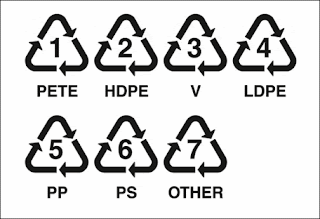
Always look for these symbols on plastics to recycle!!!

Plastic soup @ NMA

Yesterday at the National Marine Aquarium in the science lab we learnt what was in a Common dolphin stomach inside the dolphins stomach.  There were two squids, seven pieces of plastic, one big fish, three small fish, one bottle lid, one bottle, two lolly pop sticks and one straw. We thought that there would be in the Common Dolphin cold blood, fish food and fish. We learnt that we have to start to help the environment and to start recycling and making sculptures maybe out the plastic.  Make sure you don't flush away, or put in the bin any plastic!!!

Plastic Soup @ NMA

Yesterday at the NMA in the science lab we were looking at the things inside fishes stomach. Our sea creature was the Giant Trevally. These were the things inside it : 2 Squid, 3 little fish, 4 pieces of wood, 4 lolly pop sticks, Lots of plastic, 3 tooth paste lids, 2 bits of rope, 1 pen lid. We thought this creature would eat : Shrimp, Plankton, Plaice, Crab, Eel. We must not drop litter at home school or anywhere!!!!!!!!!

Plastic soup @ NMA

In the National Marine Aqurium science lab we were finding out what was in animals stomachs. In the ocean sun fishes stomach was , 1 little fish, squid, rope, 3 shrimps, plastic, wood and bone also 4 bottle tops. We also did some drawings of the fish and sharks in the National Marine Aqurium. Me and Shaun will never drop a single piece of rubbish anywhere again!

World Book Day


- Posted using BlogPress

Thursday, 1 March 2012

National Marine Aquarium


Plastic Soup

We have had a great day at the National Marine Aquarium today. We are posting some photos of the Science Laboratory workshop BUT not any information yet. The class will be posting their own accounts tomorrow!


This is the 5 Gyres website.

Tuesday, 28 February 2012

Evaporating

Use your explanation skills and the science vocabulary to explain what is happening in this video. Think about...what you started with, what you did, what happened and what you ended with.
Keywords:
sugar, solution, separated, water, residue, heat, crystals, change, reversible, candle, container, candle holder, heat, scissors, safety box

Followers